What I found when I stopped taking Oracle’s AI at face value and started asking hard questions.
I’ll be honest with you: I didn’t plan to go this deep.
What started as a simple curiosity about how AI makes decisions inside Oracle HCM turned into weeks of reading research papers, crawling through Oracle documentation (and trust me, that is an ocean), and sitting with some genuinely uncomfortable questions. Questions like: When an AI recommends that an employee shouldn’t be promoted, how do we know it’s not biased? When a benefits agent tells me my deductible is $1,240, how did it get there? And if Oracle’s AI is making these decisions for thousands of employees inside regulated industries, what’s governing that behavior behind the scenes?
This blog is my attempt to share what I’ve found. I’m not an ML engineer. I’m a practitioner, someone who implements and advises on Oracle HCM solutions for large enterprises. But I’ve been doing a lot of learning lately, and I think what I’ve uncovered is genuinely important for anyone who works in this space.
Let’s start from the beginning.
The Problem No One in HCM Is Talking About Loudly Enough
AI in HR is not new. Recruitment tools are filtering resumes. Attrition models are predicting who’s about to quit. Workforce planning systems are forecasting headcount gaps years out. Performance management tools are surfacing who should be on the fast track and who needs coaching.
All of this sounds great. And it often is.
But here’s the thing that keeps me up at night: most of these AI systems are what researchers call black boxes. They give you an answer, a score, a recommendation, a prediction, but they don’t tell you why. And in HR, “why” isn’t just a nice-to-have. “Why” is the difference between a fair decision and a discriminatory one. “Why” is what a compliance officer is going to ask you when something goes wrong. “Why” is what an employee deserves when AI has influenced their career.
The challenges I keep running into are the same ones organizations face every day:
- Black-box models are the elephant in the room. A model can have 93% accuracy and still give you zero visibility into how it reached that conclusion. That’s great for math. Terrible for accountability.
- Bias is embedded more deeply than most people realize. If an AI model is trained on historical HR data that reflects past discrimination, in hiring, in promotions, in compensation, then the AI learns those patterns and replicates them. It’s not malicious. It’s mathematical. And that’s almost scarier.
- Explainability is still largely an afterthought. Most AI tools don’t come with a plain-English explanation of their reasoning. Without that, HR professionals and employees can’t question, validate, or improve automated decisions.
- Auditability becomes a nightmare. Regulators and internal auditors are starting to ask for documentation trails for AI decisions. If you can’t reconstruct why the model flagged someone for attrition risk six months ago, you have a governance problem.
In some research I read on this topic, I found that frameworks combining explainability, fairness assessment, consistency, and auditability can reduce bias indicators by 21% and improve transparency prediction accuracy to 91.3%, compared to traditional approaches that measure only accuracy and performance. The point isn’t just the numbers. The point is: when we measure transparency properly, AI gets better for humans. And in HCM, AI has to be better for humans, because the humans it’s affecting are people’s livelihoods.
Two Popular Tools That Explain Explainability (Globally and Locally): SHAP and LIME
There are many other tools and wrappers available for AI and machine learning, but two popular ones come up again and again in research papers.
SHAP: SHapley Additive Explanations
SHAP comes from cooperative game theory. Imagine a soccer team wins a match. How much did each player contribute to that win? SHAP asks the same question about AI features. When a model predicts that an employee is likely to leave the company, SHAP breaks down exactly how much each factor contributed: tenure, salary relative to market, manager feedback score, last promotion date, department.
The beauty of SHAP is that it works at two levels. It can tell you why this specific employee got flagged (local explanation), and it can tell you which factors matter most across all employees (global explanation). For HR, this is gold. It means an HR business partner can sit down with a manager and say: “Here’s why the system thinks this person is at flight risk, and here’s the factor we have the most control over.”
LIME: Local Interpretable Model-Agnostic Explanations
LIME takes a different approach. Instead of looking at the whole model, it zooms in on a single prediction and creates a simplified, readable version of the model’s behavior just around that decision. Think of it like asking someone to explain a complex contract by simplifying the three clauses that apply specifically to your situation.
What makes LIME particularly useful is that it’s model-agnostic, meaning it works regardless of whether the underlying model is a random forest, a neural network, or gradient boosting. For enterprise HCM environments where different AI vendors are using different architectures, that flexibility matters.
So Where Does Oracle Stand on All This?
Here’s where my research got interesting, and I’ll admit I went down quite a rabbit hole.
I was searching Oracle’s documentation, developer blogs, and product pages looking for explicit references to explainability frameworks, something that said: “Here’s how Oracle HCM’s AI explains its decisions. Here’s our SHAP integration.”
And I couldn’t find it. Not explicitly.
Now, before you read that as a criticism, let me be clear: I may have missed something. Oracle’s documentation is genuinely vast, and I’m still exploring. But what I did find was something arguably more important. Oracle has been building an entirely different kind of transparency, not at the model level (like SHAP or LIME), but at the execution level. The framework they’ve built for it is something I’m now calling METRO.
METRO: Oracle’s Framework for Agent Transparency
METRO isn’t Oracle’s official acronym, at least not yet. But as I read through Oracle AI Agent Studio’s observability and evaluation documentation, the five built-in capabilities form a word, and more importantly, they form a complete system for understanding what’s happening inside an AI agent at every stage.
M: Measurement
The consistent, automated capture of quality, performance, and cost metrics for every prompt and every agent interaction. This isn’t just counting tokens. It’s measuring semantic correctness, latency, error rates, and cost, continuously, across every version of every agent.
E: Evaluation
Design-time testing before deployment. Oracle AI Agent Studio lets teams build evaluation datasets, pairs of questions and expected answers, and run those against agents before they go live. Critically, they use LLM-as-a-Judge (LaaJ): another large language model that scores the agent’s responses on a 0-to-1 semantic correctness scale, with an explanation of why it gave that score. Human evaluators can override these scores where needed.
T: Tracing
Step-by-step visibility into exactly what an agent did during a session. You can see every LLM call, every tool invocation, the latency of each step, what was retrieved from the knowledge base, what API was called, and what the agent’s reasoning was at each point. It’s like getting a receipt with a full audit trail for every AI decision. For regulated industries, this is enormous.
R: Reporting
Drill-down dashboards, leaderboards comparing agent versions, evaluation run histories, A/B comparisons between prompt versions. Reporting takes all the raw data and turns it into something both engineers and business leaders can act on.
O: Observability
Production-grade, ongoing monitoring after deployment. This includes filters by time window, error rate tracking, anomaly detection, and the ability to drill into specific failing interactions. This is where “did the agent behave correctly this morning” lives.
Together, METRO is Oracle’s answer to: how do we know this AI agent is doing what it’s supposed to do? For anyone implementing AI in Oracle HCM, this framework is not just technical architecture. It’s your governance foundation.
Oracle’s Approach to Trustworthy AI
While METRO addresses agent-level transparency, Oracle has been building something more fundamental underneath all of it: a philosophy and architecture they call Governed Execution.
“AI governance is not a policy wrapper around a model. It is a runtime assurance architecture for controlling what AI systems can access, decide, and do.” (Oracle AI & Data Science Blog)
This is a real shift in thinking. Most people, when they think about AI safety, think about the model itself. Is the model biased? Does it hallucinate? Oracle’s argument is that model safety is necessary but not sufficient for enterprise AI.
As AI moves from chatbots to actual agents that take action, updating records, calling APIs, querying databases, the risk surface changes completely. Oracle frames this clearly:
- Chatbots create answer risk: the model might say something wrong or harmful
- RAG systems create context risk: the retrieved information might be stale, wrong, or unauthorized
- Agents create action risk: the agent might do something wrong, and unlike text, actions can be irreversible
Oracle’s Governed Execution architecture addresses all three levels. Every time an AI agent proposes an action, it passes through a Runtime Controller, essentially a policy enforcement point that evaluates who is asking, what data it needs, what tool it’s trying to call, whether the action is reversible, and what evidence needs to be captured. The model never directly executes a tool. It proposes an action. The runtime controller decides whether that action is allowed, denied, requires review, or should be degraded to a safer mode.
Oracle’s three-layer trustworthy AI assurance model is worth knowing:
- Layer 1: Foundation. Is the model and data safe for this use case? Bias testing, red-teaming, model evaluation.
- Layer 2: Workflow. Does the system behave safely inside the workflow? Tool governance, human-in-the-loop approvals, policy enforcement at runtime, budget guardrails.
- Layer 3: Production. Does safety hold over time? Continuous monitoring, drift detection, incident response, feedback loops.
Trustworthy AI is not a one-time certification. It is an operating model.
How an Oracle AI Agent Actually Works: A Walk-Through
Let me bring all of this to life with a concrete example, because this is where the understanding really clicks.
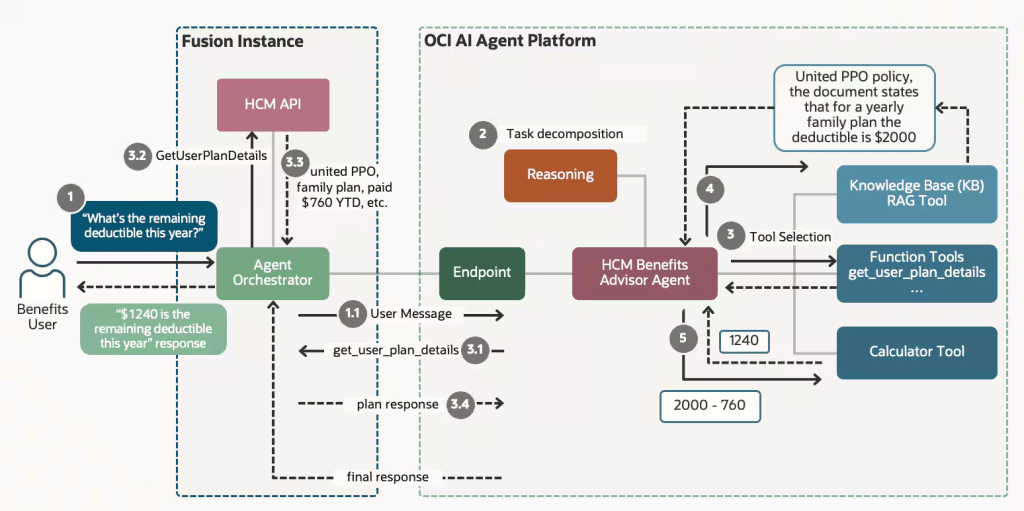
Oracle published a detailed walkthrough of what happens when an employee asks their HCM Benefits Advisor Agent: “What’s my remaining deductible this year?” It sounds simple. But what happens behind the scenes involves multiple layers of intelligence, tools, and governance.
Step 1: The Employee Sends a Message
The employee types their question into a chat interface in Oracle Fusion. That message travels through an endpoint, Oracle’s managed deployment surface, to the OCI AI Agent Platform.
Step 2: Task Decomposition
The agent doesn’t just answer the question directly. It first reasons about the question using a technique called ReAct (Reasoning + Acting), breaking it into subtasks: find what health plan this employee is on, get their year-to-date claims data, look up the deductible for that plan, calculate the remaining amount.
Step 3: Tool Selection
The agent identifies the right tools to call:
- A Function Tool called get_user_plan_details, which retrieves the employee’s health plan enrollment from Oracle HCM
- A Knowledge Base (RAG Tool), which contains the actual plan documents
- A Calculator Tool, to compute 2000 minus 760 = $1,240
Here’s an important detail: the execution request for the HCM API is delegated back to the Fusion orchestrator, the middleware layer inside Oracle Fusion. This means the HCM API never needs to be exposed directly to the agent. The Fusion environment controls authentication, authorization, and the actual API call. Security remains inside the enterprise boundary.
Step 4: Knowledge Retrieval (RAG)
While the API call is happening, the agent also queries the knowledge base using Retrieval Augmented Generation (RAG), finding that “for a United PPO family plan, the annual deductible is $2,000.” This grounds the agent’s response in actual documentation rather than making up numbers.
Step 5: Calculation and Response
The calculator tool runs: $2,000 minus $760 YTD = $1,240 remaining. The agent generates its response, which passes through output guardrails before being returned to the employee.
The entire flow from question to answer happens in seconds. The employee never sees any of this complexity. But as a consultant, understanding this flow is everything, because when something goes wrong, you need to know where to look. This is where Oracle’s Tracing capability (the T in METRO) becomes your best friend.
The OCI + Fusion HCM Architecture
Let me zoom out for a moment, because the architecture is worth understanding even at a high level.
- Oracle Cloud Infrastructure (OCI) is the cloud foundation: compute, storage, networking, and AI services. This is where the large language models live, including models from Cohere, Meta (LLaMA), OpenAI, and xAI.
- OCI AI Agent Platform sits on top of OCI. This is the managed platform for building and deploying AI agents. It provides the Agent Core (reasoning engine built around ReAct), the Tool Use layer, the RAG infrastructure, guardrails, and security controls.
- Oracle Fusion HCM is the application layer, the HR system of record. Fusion HCM embeds agents natively into its workflows. The Benefits Advisor Agent, Compensation Assessment Agent, Hiring Advisor, and Payslip Advisor are all built on OCI AI Agent Platform but surfaced inside the Fusion HCM user experience.
- Oracle AI Agent Studio is the no-code toolkit within Fusion for configuring, testing, evaluating, and monitoring these agents. This is where METRO lives.
The relationship between OCI and Fusion HCM is foundational. OCI provides the intelligence. Fusion provides the business context, the data, and the security boundary. That tight integration is one of Oracle’s strongest arguments against point solutions that try to add AI to HR systems through third-party integrations.
The Explainability Gap
Oracle has built an impressive governance and observability architecture. METRO gives you traceability at the agent level. Governed Execution gives you runtime policy enforcement. The three-layer assurance model gives you a framework for thinking about safety across the AI lifecycle.
But here’s the thing: Oracle has not yet explicitly published its approach to model-level explainability in the same way that SHAP and LIME provide it. There is no publicly documented Oracle-native equivalent of “here is which HCM data features most influenced this attrition prediction, with each factor’s weight.” I am still researching. Oracle has a wealth of documents, papers, and articles, and it may simply be that I haven’t found it yet, or that Oracle hasn’t made it public yet. Either way, I’ll keep looking.
If you know about this, or you are a data engineer, data scientist, or ML specialist working in Oracle Cloud, I genuinely want to hear from you.
I want to be fair here: this gap is also partly a feature architecture question. Oracle’s AI agents operate at a higher level of abstraction than simple predictive models. SHAP and LIME were designed for “will this employee leave?”-style models. For agent-based AI that performs complex multi-step tasks, the explainability challenge is different and arguably harder.
That said, model-level explainability remains a critical concern for regulated industries deploying Oracle HCM AI. A healthcare company or a bank using Oracle HCM to influence hiring, promotion, or performance decisions has legal and regulatory obligations that go beyond “the agent traced its steps.” They need to demonstrate, at the feature level, that protected attributes (gender, age, ethnicity) did not influence the model’s recommendations.
This is an area I’m actively continuing to research. And it’s one I think every major HCM vendor needs to invest in further.
What This Means If You’re an Oracle HCM Consultant
Let me close with the practical takeaway, because I know many of you reading this are practitioners like me.
- Stop treating AI in Oracle HCM as a configuration task. AI agents are not workflows. They’re not business rules. They’re nondeterministic, multi-step, adaptive systems. You need evaluation datasets. You need to understand tracing. You need to understand what “correctness” means semantically. Also, some understanding of what model they used, what are their training data set, what are the accuracy score. This may help our clients as this are fundamental questions.
- Learn the architecture. Understanding that OCI AI Agent Platform sits between OCI Generative AI Service and Oracle Fusion HCM, and understanding the separation of responsibilities between them, is becoming essential knowledge for any serious Oracle practitioner.
- METRO is your audit trail. If you’re implementing Oracle HCM AI for a client in a regulated industry, METRO is how you demonstrate governance to auditors, compliance officers, and executives. Learn it. Use it. Build it into your deployment methodology. And honestly, I wish we had a scorecard for each METRO parameter that we could show clients as a confidence indicator.
- Ask the explainability question. For every AI use case you’re deploying in HCM, particularly anything that influences hiring, promotion, compensation, or termination, ask: “What explains this decision, and can we demonstrate that protected attributes didn’t drive it?”
- Governance is a competitive advantage. Organizations that build trustworthy AI governance early will be faster to deploy, easier to audit, and more trusted by their workforce. That’s not just good ethics. That’s good business.
I’m Still Curious and Exploring
I’m still digging. There are questions I don’t have full answers to yet.
I want to understand whether Oracle HCM’s predictive models have any feature attribution capabilities that aren’t publicly documented. I want to understand how Oracle plans to bridge model-level explainability (SHAP/LIME style) with agent-level observability (METRO). I want to see how the NIST AI Risk Management Framework maps onto Oracle’s three-layer assurance model in practice.
If you’re working on any of these questions, or if you’ve found something in Oracle’s documentation that I missed, I genuinely want to hear from you. This is a space where practitioners need to be learning together.
Because here’s what I know for certain: AI is not coming to HCM. It’s already here. The question isn’t whether it will make decisions that affect people’s careers. It’s whether those decisions will be transparent, fair, governed, and trustworthy.
That’s the work. And I’m in it for the long haul.
References
Oracle Blog: Building Trustworthy AI at Oracle: https://blogs.oracle.com/ai-and-datascience/building-trustworthy-ai-at-oracle
Oracle Blog: First Principles, OCI AI Agent Platform is a New Frontier for Enterprise Automation: https://blogs.oracle.com/cloud-infrastructure/first-principles-oci-ai-agent-platform
Oracle Guide: AI Agents Observability and Evaluation (PDF): https://www.oracle.com/a/ocom/docs/applications/fusion-apps-ai-agents-observe-eval-guide.pdf
YouTube: Oracle AI Agents in Action: https://youtu.be/cLcytKayZF8?si=mV1xLwYd2Huihgnr
About the Author: Sudarshan Mondal is an Oracle HCM Cloud architect with 24+ years of experience helping global organizations transform how they manage their people. He has designed and delivered HCM Cloud implementations across Healthcare, Higher Education, Energy, and Financial Services, covering Core HR, Payroll, Compensation, and Benefits. He writes about enterprise technology, workforce strategy, and the evolving role of HR in large organizations. All content on this site reflects his personal opinions and does not represent the views of his employer or any affiliated organization.


Leave a Reply