For years, AI in enterprise software meant one of two things: a bolt-on analytics module nobody fully trusted, or a research project that lived on a roadmap slide. Oracle has changed that equation in a meaningful way — and if you are running Oracle Fusion Cloud Applications, the change is already inside your system.
Oracle AI for Fusion Applications is not a separate product you purchase, deploy, or integrate. It is a layer of intelligence embedded directly into the features you already use — across HCM, ERP, SCM, CX, and beyond. Business insights, task automation, personalized recommendations, and performance improvement are no longer capabilities you build toward. They are capabilities you activate.
What follows is my practitioner’s breakdown of what Oracle AI for Fusion Applications actually is, the three categories of AI technology it uses, how AI Agent Studio works, and — critically — how to prompt it effectively.
What Is Oracle AI for Fusion Applications?
Oracle AI for Fusion Applications refers to the AI functionality embedded within features across Oracle Fusion Cloud Applications. These capabilities are designed to help organizations get business insights faster, automate routine tasks, access personalized recommendations, and improve overall business performance.
Three design principles set it apart from most enterprise AI implementations:
Prebuilt, not custom-built. The AI features are built into the platform. You do not need data science expertise, machine learning models, or a team of developers to use them. They are ready when your environment is.
Self-serviceable. Features can be enabled and configured without an external system integrator. For organizations that have spent years dependent on consultants for every configuration change, this is a significant shift.
Enterprise-integrated by design. Oracle AI operates within your existing security configurations, data privacy policies, and access controls — it does not sit outside your governance framework, it operates inside it.
Three AI Technologies Powering Oracle Fusion
Oracle AI in Fusion Applications is not a single technology — it is a deliberate combination of three distinct AI paradigms, each suited to different types of business problems.
Predictive AI
Statistical Machine Learning · Pattern Recognition
Predictive AI uses statistical machine learning models to identify patterns in historical data and generate predictions on new data. In Oracle HCM, this powers flight risk detection, performance trend analysis, and workforce planning signals — surfacing who needs attention before the situation becomes critical.
The key practitioner insight: predictive outputs are probabilities, not certainties. They tell you where to look. What you do next is a human decision.
Generative AI
Large Language Models · Multimodal AI
Generative AI uses large language models (LLMs) and multimodal AI to generate text and media content based on input instructions and context data. In Fusion Applications, this surfaces in job description drafting, offer letter generation, performance review summaries, and employee communications — tasks that once consumed hours of manager time.
Quality of output is directly proportional to quality of prompt. This is where prompt engineering becomes a practical skill, not just a theoretical concept — more on that below.
Agentic AI — AI Agents & Agentic Apps
Autonomous Action · Multi-Agent Orchestration
Agentic AI represents the most significant shift in how enterprise software operates. These are advanced AI models that work in continuous loops — analyzing inputs, planning steps, identifying required resources, and taking action through tools and sub-agents. Unlike Predictive or Generative AI, which produce outputs for humans to act on, Agentic AI takes action itself.
Within Oracle Fusion, this manifests in two forms:
AI Agents are software entities that run tasks autonomously across processes. They are language-based (interpreting and generating natural language), context-aware (incorporating user role, business data, and interaction history), and action-taking (triggering and running tasks based on AI-driven decisions).
Agentic Apps are applications composed of multiple AI agents coordinating autonomously to achieve a desired business outcome — think of them as orchestrated teams of AI specialists, each handling a domain of a larger workflow.
Oracle AI Agent Studio: Building Agents Without Code
Oracle AI Agent Studio is where the agentic AI story becomes tangible for business users and implementers. It provides a low-code environment to create, configure, and deploy AI agents directly within Oracle Fusion Cloud Applications — no external development required.
Understanding its structure is essential before you build anything in it.
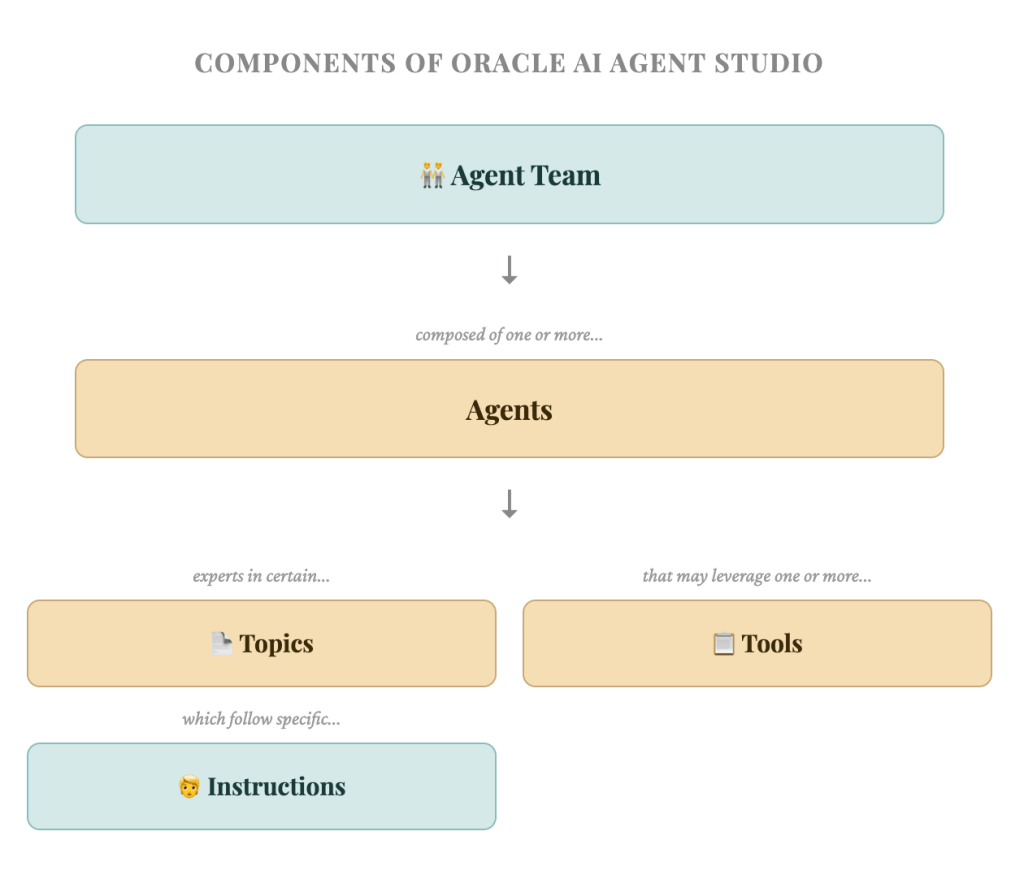
The architecture is elegantly hierarchical: an Agent Team is the top-level structure, composed of one or more Agents. Each agent is an expert in specific Topics — following defined Instructions — and may leverage one or more Tools to take action within Fusion Applications.
Here are the seven key capabilities available within AI Agent Studio:
| Capability | What It Does |
|---|---|
| Agent Template Libraries | Use templates and natural language prompts to create or fine-tune agents for common business scenarios — such as opportunity-to-quote processing and shift scheduling. |
| Agent Team Orchestration | Configure multiple agents to collaborate on multistep processes, with user approvals integrated where necessary — keeping humans appropriately in the loop. |
| Agent Extensibility | Extend existing agents in Oracle Fusion Cloud by incorporating new data sources, prompts, and APIs to fit specific business or industry requirements. |
| Native Fusion Integration | Directly access APIs and tools in Fusion Applications — ensuring seamless agent deployment without complex modifications or middleware. |
| Third-Party Integration | Connect with external systems and collaborate with third-party agents for end-to-end automation with secure API support. |
| Trust & Security Framework | Automatically applies Fusion Applications’ security configurations, policies, and access controls — ensuring agents operate within enterprise compliance standards. |
| Validation & Testing Tools | Built-in tools to verify AI-driven flows before deployment — making agents reliable, repeatable, explainable, and secure. |
“The quality of what Oracle AI produces is directly proportional to the quality of what you ask it. Prompt engineering is not a technical skill — it is a business communication skill.”
Prompting Oracle AI Effectively: 8 Best Practices
Whether you are working with Generative AI features or configuring agent instructions in AI Agent Studio, how you write your prompts determines the quality of your outcomes. These are Oracle’s eight best practices — with my practitioner’s read on each:
Practice 01: Start Simple and Iterate
Prompt engineering is iterative. Begin with a simple prompt, evaluate the response, then refine. Trying to write the perfect prompt on the first attempt wastes more time than it saves.
Practice 02: Experiment with Structure
Small changes in word order, line spacing, and information placement can produce meaningfully different outputs. Test structural variations before concluding a prompt “doesn’t work.”
Practice 03: Use Detailed Commands
Use explicit action verbs: Write, Summarize, Classify, Translate, Order. Vague instructions produce vague results. The model needs to know exactly what task it is performing.
Practice 04: Be Specific
Descriptive and detailed prompts consistently generate better outputs — especially when targeting a particular result or communication style. Specificity is the single highest-leverage prompt improvement.
Practice 05: Be Mindful of Length
Balance simplicity with sufficient detail. Every element of your prompt should earn its place. Unnecessary context dilutes the instruction — and models weigh later information more heavily in some cases.
Practice 06: Specify the Output Format
Always specify the exact output format required for your Oracle Fusion context. A performance summary formatted for a manager dashboard reads very differently from one formatted for a legal review.
Practice 07: Avoid PII in Prompts
Never include personally identifiable information in prompts, for privacy and security reasons. Use role-based or anonymized references instead — the AI does not need names to generate effective outputs.
Practice 08: Test Thoroughly
Test with both expected inputs and edge cases — “sad path” scenarios designed to challenge the model. A prompt that works perfectly in ideal conditions but fails on unusual inputs is not production-ready.
The Practitioner’s Takeaway
Oracle AI for Fusion Applications is the most coherent AI integration I have seen in an enterprise HCM and ERP platform. It is not AI layered on top of existing software — it is AI woven into the fabric of how work flows through the system.
But the organizations that will realize its full value are those that invest in three things beyond the technology itself: clean foundational data that the AI can actually learn from, well-designed business processes that define where AI acts and where humans decide, and prompt literacy across the HR and finance functions — because every person who interacts with Oracle’s Generative AI features is, effectively, working with a communication tool.
The technology is ready. The question, as always, is whether the organization is.
Practitioner Note:
If you are planning to enable AI Agent Studio in your Oracle environment, start with the validation and testing tools before anything goes near production. The built-in testing capability exists for a reason — AI-driven automation errors in payroll, compensation, or benefits can cascade quickly. Verify the agent’s behavior across both happy-path and edge-case scenarios before deployment.
About the Author
Sudarshan Mondal is an Oracle HCM Cloud architect and thought leader with 24+ years of experience helping global organizations reimagine how they manage their people. A seasoned Oracle practitioner, he has designed and delivered complex HCM Cloud implementations across Healthcare, Higher Education, Energy, and Financial Services — spanning Core HR, Payroll, Compensation, and Benefits. He writes at the intersection of enterprise technology, human capital strategy, and the future of work.
All content on this site represents his personal opinions and does not reflect the positions of his employer or any affiliated organization.
#OracleAI#OracleFusionCloud#AgenticAI#AIAgentStudio#GenerativeAI#OracleHCM#FutureOfWork#HRTechnology#PromptEngineering#EnterpriseAI


 Sudarshan Mondal
Leave a comment