Oracle lets you override the default Generative AI prompts built into Fusion Application pages like Performance, Recruiting, and more. Instead of accepting out-of-the-box AI behavior, you can tailor it to fit your organization’s voice, context, and process needs.
The tool that makes this possible is the AI Configurator, sitting right inside HCM Experience Design Studio. And it’s available across all Fusion Applications, not just HCM.
Why This Matters
Out-of-the-box AI prompts are designed to work for everyone, which means they’re optimized for no one in particular. Your organization has its own language, its own process context, and its own expectations for how AI-generated content should read. The AI Configurator gives you a supported, sandbox-safe way to close that gap without touching any underlying code.
In my experience, this is one of the most underused capabilities in Oracle Fusion. Once practitioners know it exists, the use cases start coming quickly: performance review language that reflects the company’s competency framework, recruiting summaries that match the tone of the talent acquisition team, and compensation narratives that align with how the business actually talks about pay.
How to Get There
The steps are straightforward once you know where to look.
Step 1. Make sure you have the required privilege: Access HCM Page Configurator (HRC_ACCESS_HCM_TRANSACTION_CONFIGURATOR_PRIV).
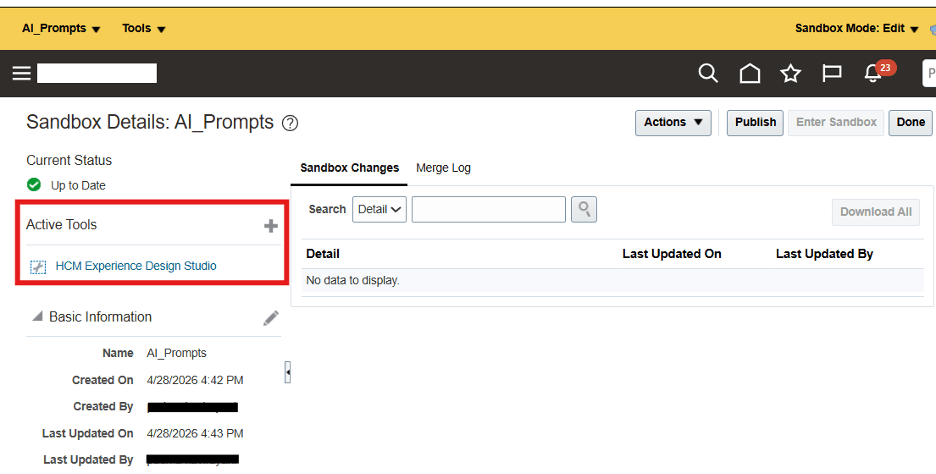
Step 2. Create and activate a Sandbox with HCM Experience Design Studio enabled.
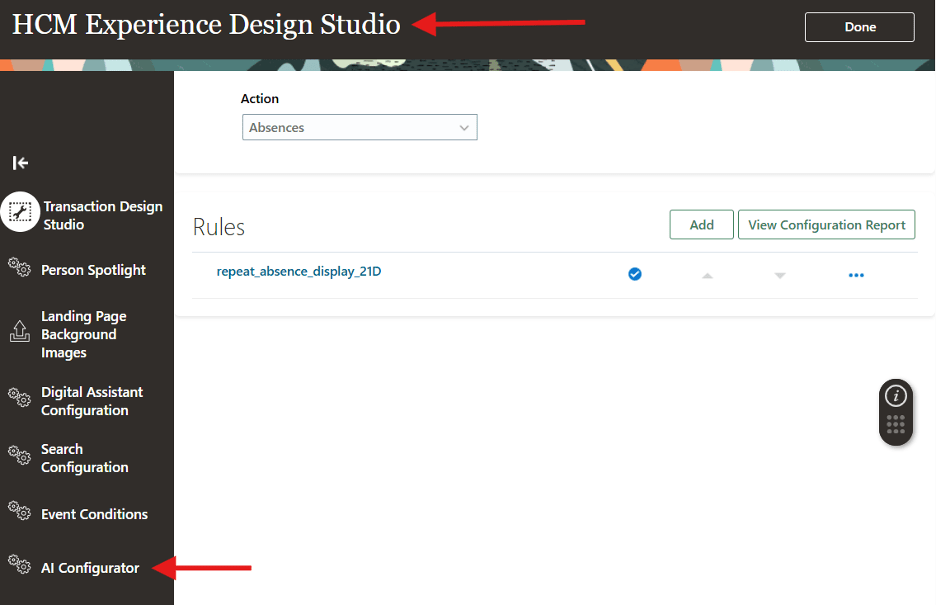
Step 3. From the sandbox bar, navigate to Tools, then HCM Experience Design Studio, then AI Configurator.
Step 4. Select your product domain and module, then find the seeded prompt you want to change.
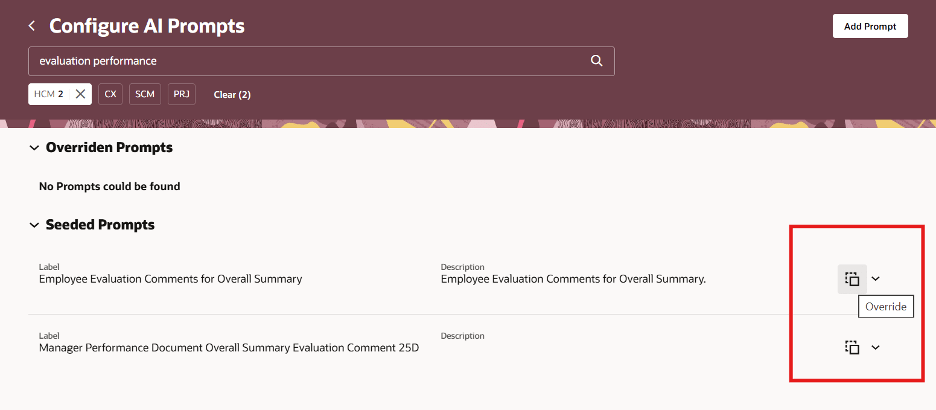
Step 5. Click Override and edit the prompt as needed.
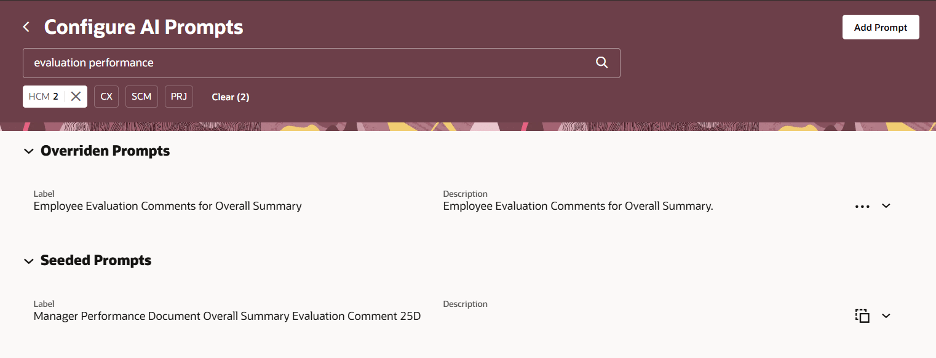
Step 6. After saving, your edited prompt appears in the Overridden Prompts section. You can test, edit, or delete it from there.
Step 7. Publish the sandbox, and your custom prompt goes live instantly for all users.
One thing worth knowing: if you ever delete the override, Oracle falls back to the original seeded prompt automatically. Nothing is permanently changed, which makes this a low-risk place to experiment.
Creating and activating a Sandbox
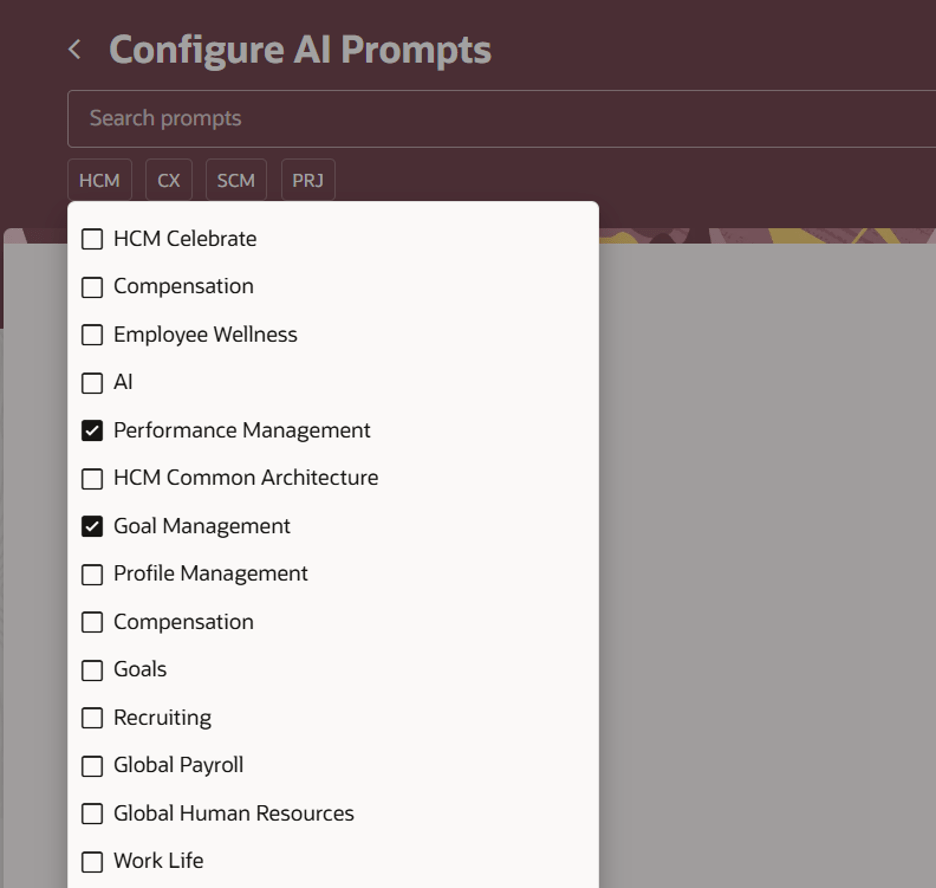
Clicking Override to customize a seeded AI prompt
The Overridden Prompts section showing your customizations
Publishing the sandbox to activate your overridden prompts
A Few Things to Keep in Mind
There are three technical guardrails that matter here, and skipping over them is where most prompt customization problems start.
Section headings. Lines beginning with # signs are section headings. They carry structural meaning inside the prompt. Handle them deliberately and don’t remove them without understanding what they control.
Prompt variables. Variables inside { } are load-bearing. The AI uses them to pull in the right context at runtime, things like employee name, role, or review period. Don’t remove them or rename them. If you do, the prompt will either fail or produce outputs missing critical information.
Output format. Some prompts expect structured output like JSON or HTML, not plain text. Changing the format incorrectly can break downstream business flows in ways that aren’t immediately obvious. Always test the full end-to-end behavior in sandbox before publishing.
A Note for Practitioners
The AI Configurator isn’t limited to HCM. It’s available across all Oracle Fusion Applications. Whether you’re working in Finance, Supply Chain, or CX, this same capability lets you fine-tune how AI responds across your business flows.
My suggestion is to start with one prompt, something low-stakes where you can clearly see the difference between the seeded output and your override. Test it thoroughly in sandbox, validate the output format, and then publish. Once your team sees what’s possible, the conversation about where else to apply it usually takes care of itself.
Small prompt changes can unlock meaningfully better AI experiences for end users. If you haven’t explored the AI Configurator yet, it’s worth setting aside an hour to look.
About the Author: Sudarshan Mondal is an Oracle HCM Cloud architect with 24+ years of experience helping global organizations transform how they manage their people. He has designed and delivered HCM Cloud implementations across Healthcare, Higher Education, Energy, and Financial Services, covering Core HR, Payroll, Compensation, and Benefits. He writes about enterprise technology, workforce strategy, and the evolving role of HR in large organizations. All content on this site reflects his personal opinions and does not represent the views of his employer or any affiliated organization.



Leave a comment