The Big Picture: Why 26D Matters
Oracle HCM is moving from screens people navigate to work that agents help complete. Update 26D for Global HR makes that direction concrete.
The release carries roughly 70 Global HR features. Read one by one, most look small. Read together, they tell a clear story about where the platform is heading.
In this edition
- Technology direction: the three shifts reshaping Oracle HCM
- For business users: what will feel different for HR, managers and employees
- For practitioners: what to test, configure and protect
- My perspective: where enterprise HCM is heading next
Technology Direction: Three Shifts Reshaping Oracle HCM
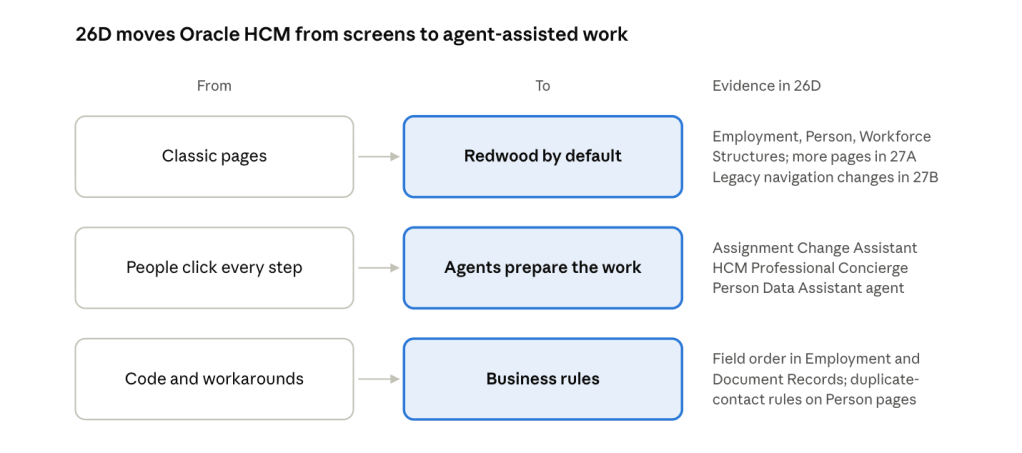
Oracle is building a platform where the experience is one design system, agents draft the work, and rules replace custom code.
Shift 1: Redwood becomes the only experience
Redwood is now on by default for Employment, Person and Workforce Structures pages. More Employment and Positions pages follow in 27A, and legacy Person navigation changes in 27B.
Shift 2: AI agents move into core transactions
About ten 26D features carry Oracle’s “AI agent” tag. They sit inside assignment changes, document records, journeys and person data, not beside them.
Shift 3: Configuration moves from code to business rules
Field order, duplicate checks and display controls are now set through business rules. Customers can shape the experience without customizations that break with each update.
Each shift builds on the one before it. Agents need Redwood to run inside transactions, and rules give customers a safe way to shape both.
What It Means for Business Users
For HR leaders, managers and employees, 26D means less clicking and more guided work.
HR leaders: a change-management moment
Redwood by default touches every HR user. Treat it as an adoption program, with communication and training, not a silent upgrade.
HR operations: agents prepare, people approve
AI assistance in the Assignment Change Assistant, plus the new HCM Professional Concierge Workspace and Workflow Agent, shift specialists from keying data to reviewing it.
Managers: one place to act on the team
The Team Activity Center brings consolidated actions and goal assignment together, instead of scattering them across menus.
Employees: simpler self-service
The Person Data Assistant replaces separate personal-information agents. Collection tasks now appear in My Tasks and as nudges, so onboarding steps are easier to finish.
Global organizations: faster multilingual rollouts
Generative AI now translates actions, action reasons, assignment statuses and workforce structures such as departments, jobs and locations.
The takeaway for leaders: these changes shift who does the work, a specialist or an agent, and where people go to do it.
What It Means for Practitioners
For consultants and HRIS teams, the work is in testing, setup decisions and migrating what already exists.
Test first: the four larger-scale features
Oracle rates only four 26D features as larger scale:
- Redwood enabled by default for Employment pages in 26D
- Redwood enabled by default for Employment pages in 27A
- Enhancements to the Assignment Change Assistant with AI Assistance
- Protect Correct Termination Changes for Multi-Row EFF
Plan the Redwood runway to 27B
Inventory classic-page personalizations, job aids and test scripts that will move. Plan the change in waves rather than one cutover.
Move off retired agents
The Personal Information Assistant and Person Legislative Information agents are replaced by the Person Data Assistant agent. The Representative Agent (Supervisor Agent Type) is being deprecated.
Configure, don’t customize
Use business rules for field order in Employment processes and Document Records pages, duplicate family and emergency contacts, and display controls on Person pages.
Revisit long-standing pain points
- Propagate historical assignment changes to future records
- Retain transaction changes when the effective date moves
- Configure termination and resignation dates in Redwood
Protect security, journeys and payroll
- Security: separate line manager access to work patterns, Journey Task Library security, and role access for every new agent
- Journeys: the Process Automation task type is no longer available; performer groups and force-close are new
- Payroll interfaces: baseline extractions are now available for Global Payroll Interface V2 and the ADP interfaces; agree the approach with your provider first
My Perspective: From System of Record to System of Work
For two decades, HCM programs were judged by how well they stored and secured worker data. 26D shows the measure shifting to how much work the system helps complete.
Data quality is now an AI readiness issue
An agent that proposes an assignment change is only as good as the jobs, positions and history it reads. Clean workforce structures used to be good hygiene. Now they decide whether AI can be trusted.
Governance is a design task, not an afterthought
Every agent needs clear answers to three questions: what can it see, what can it change, and who approves it. Those answers belong in security and workflow design before go-live.
Customers are shaping the roadmap
Many 26D features carry the Idea Lab tag, from termination dates to mass legal employer changes. Practitioners who post and vote there help set the direction.
The practitioner role is evolving
Less time building screens and workarounds. More time on process design, data readiness and helping HR teams trust a system that now acts, not just records. I see that as good news for our profession.
The Bottom Line
Quarterly updates are easy to treat as a checklist. 26D is worth reading as a signal. Organizations that prepare their data, security and people now will adopt 27A and 27B smoothly instead of catching up.
What trends are you seeing in your Oracle HCM programs? I would love to hear how other leaders and practitioners are approaching them.
About the Author: Sudarshan Mondal is an Oracle HCM Cloud architect with 24+ years of experience helping global organizations transform how they manage their people. He has designed and delivered HCM Cloud implementations across Healthcare, Higher Education, Energy, and Financial Services, covering Core HR, Payroll, Compensation, and Benefits. He writes about enterprise technology, workforce strategy, and the evolving role of HR in large organizations. All content on this site reflects his personal opinions and does not represent the views of his employer or any affiliated organization.


Leave a Reply