Across every industry, the definition of best practice is being rewritten. The pandemic accelerated workforce fragmentation, regulatory complexity multiplied, and employee expectations shifted in ways that aren’t going back. HR leaders are now expected to deliver personalized, responsive, and globally compliant workforce experiences, often with leaner teams and tighter budgets.
The technology platform you choose either enables that mission or quietly undermines it. Having spent over two decades implementing Oracle HCM across Healthcare, Higher Education, Energy, and Financial Services, I’ve seen firsthand what separates organizations that thrive from those that merely survive: the quality of their foundational HCM infrastructure.
Oracle Fusion Cloud HCM is a platform I’ve both implemented and staked client outcomes on. Here is why organizations continue to choose it, and why those reasons hold up under scrutiny.
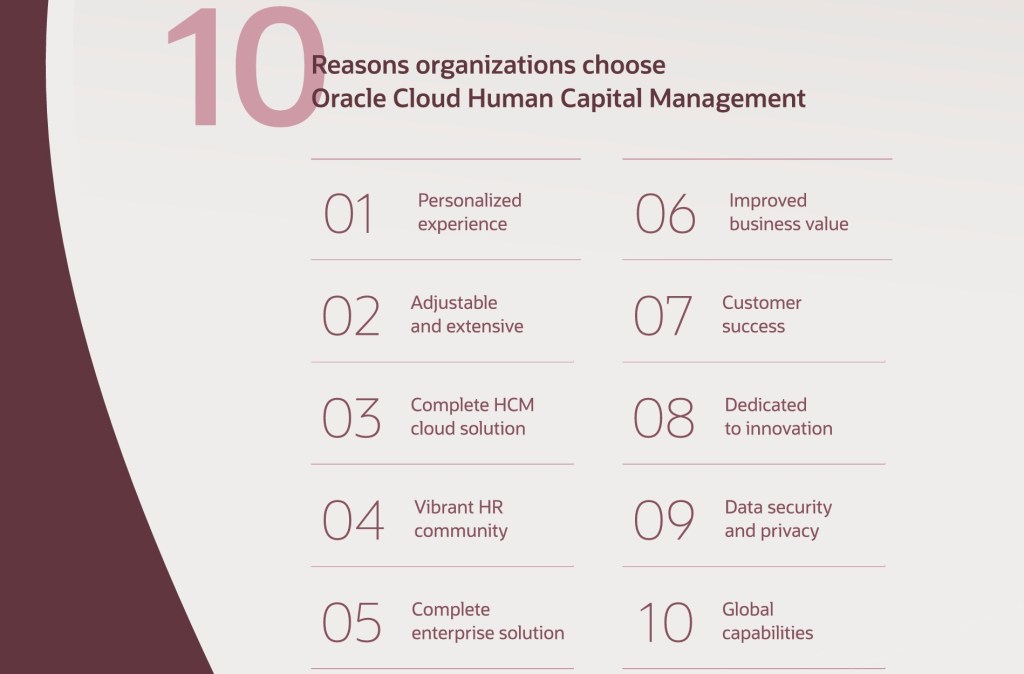
The Top 10: Beyond the Feature List
Reason 01: Tailored Employee Experience
Oracle ME is the only complete employee experience platform built natively into an HCM suite, bringing communications, workflows, listening tools, and support together in one personalized layer. In my experience, adoption improves when employees feel the system was built for them, not just configured around them.
Reason 02: Adaptable and Extensible
You can configure org structures, model workforce scenarios, and set up processes with minimal IT involvement. In fast-moving situations, a merger, a regulatory change, a restructure, this agility is the difference between weeks and months of response time. That’s not a small thing when the business is waiting on HR.
Reason 03: Complete HCM Cloud
A single platform covering talent management, payroll, benefits, absence, time and labor, learning, analytics, and workforce planning. The alternative is integration debt, and anyone who has managed a best-of-breed environment knows how quickly that debt accumulates.
Reason 04: Complete Enterprise Solution
Oracle builds its SaaS on its own cloud infrastructure, creating a unified data environment across HR, Finance, and Sales. People cost management and workforce planning become genuinely connected, not just theoretically integrated through middleware that breaks on upgrade weekends.
Reason 05: Improved Business Value
Arizona Federal Credit Union now saves 60 hours of work per month. These outcomes compound over time. Better adoption drives better data, better data drives better decisions, and better decisions drive real ROI. The math works, but only if the implementation is done right.
Reason 06: Dedication to Innovation
Oracle invests $6 billion annually in R&D, with 80% of innovations driven directly by customer feedback. AI, machine learning, and digital assistants are not roadmap promises. They are embedded in the platform today, and I’ve seen them work in production environments across multiple industries.
Reason 07: Data Security and Privacy
Oracle Advanced HCM Controls provides ongoing automated monitoring of user access and activity. In a distributed workforce era, where remote access footprints have expanded considerably, this kind of continuous oversight isn’t optional. It’s a baseline requirement for any organization with compliance obligations.
Reason 08: Vibrant HR Community
Over 40,000 HCM users on Oracle Cloud Customer Connect. I’ll be honest: peer knowledge-sharing in this community has solved real implementation challenges faster than any formal support channel I’ve used. It’s one of Oracle’s underrated advantages.
Reason 09: Customer Success Model
Implementation success managers, on-demand education, and 24/7 support across 145 countries. Go-live is not the finish line, and Oracle’s support model is built around what happens after deployment. That matters more than most organizations realize during the sales process.
Reason 10: Global Capabilities
Support for 200 jurisdictions, 27 languages, and payroll localized in 13 countries. For global enterprises, the alternative is a patchwork of regional solutions that create reconciliation problems and compliance blind spots. I’ve seen what that looks like, and it’s not a cost worth saving on.
“The best HCM platform is not the one with the longest feature list. It is the one your employees actually use and trust.”
The Practitioner’s Perspective
What these ten reasons collectively represent is a philosophy: Oracle is building a platform for the long game. Integration without bolt-ons, innovation without disruption, global scale without local compromise. These are genuinely hard problems, and Oracle has invested structurally to address them.
That said, technology is never a silver bullet. The organizations I’ve seen get the most from Oracle Cloud HCM are those that invest equally in clean data, well-designed business processes, and strong change management. The platform amplifies what you bring to it. If the foundation isn’t solid, even the best technology won’t save you.
About the Author: Sudarshan Mondal is an Oracle HCM Cloud architect with 24+ years of experience helping global organizations transform how they manage their people. He has designed and delivered HCM Cloud implementations across Healthcare, Higher Education, Energy, and Financial Services, covering Core HR, Payroll, Compensation, and Benefits. He writes about enterprise technology, workforce strategy, and the evolving role of HR in large organizations. All content on this site reflects his personal opinions and does not represent the views of his employer or any affiliated organization.
 Sudarshan Mondal
Leave a comment