Payroll finally gets its Redwood moment.
I have been waiting to write that sentence for a while.
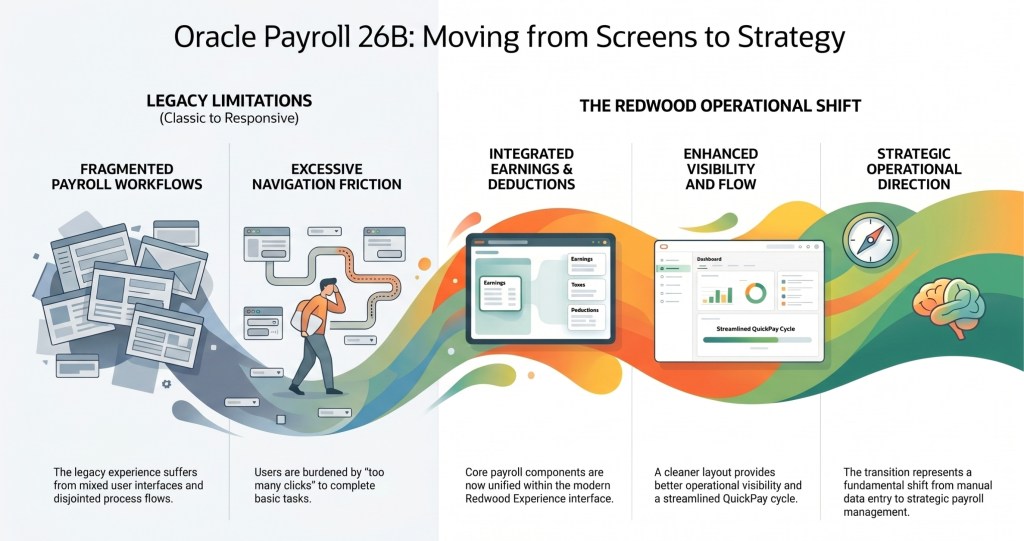
If you have implemented or run Oracle Cloud Payroll in the US, you know the friction. Three screens. Three navigation paths. Three sets of quirks to memorize. The Classic UI Element Entries screen for some things, the Responsive Standard Entries screen for others, QuickPay somewhere in between. Each one functional. Each one slightly different. None of them feeling like they belong to the same product.
Oracle 26B changes that — and it changes it in a way that matters far beyond what the release notes will tell you.
The Real Cost of a Fragmented Payroll UI
Here is what nobody says in client presentations: the fragmented UI is one of the biggest drivers of user error, training overhead, and post-go-live support tickets.
When a payroll administrator has to remember which screen handles which scenario, you create cognitive load that should not exist. You create training decks with three sets of screenshots. You create UAT cycles that take longer than they should because testers have to cover three environments instead of one.
For US payroll teams — managing federal, state, and local tax complexity alongside benefits, garnishments, and time integration — that cognitive overhead is not trivial. It adds up in every pay cycle.
What 26B Delivers for US Payroll Teams
One unified Redwood Earnings and Deductions page. The Classic UI, Responsive Entries, and QuickPay screens consolidate into a single experience. One page. One navigation. One set of behaviors to learn, test, and support. Export to Excel is included. Payroll flow history is visible per element entry — total transparency without navigating away.
Redwood QuickPay and QuickPay Cycle Flows. This one has been on the wishlist for years. Run individual retro plus QuickPay in one end-to-end flow: QuickPay → Retropay → Prepayments → Archive → EFT/Check → Payslip. In sequence. In one place. For anyone managing QuickPay testing during implementations or validating results after quarterly releases, this is a genuine game-changer.
Tax Groups. This is the larger-scale 26B feature that US payroll leaders need to assess carefully. Tax Groups allow multi-entity organizations to group tax reporting units for consolidated tax filing — a structural improvement with significant implications for complex US employers running multiple EINs. If your organization has grown through acquisition or operates across multiple legal entities, this feature warrants early evaluation before your 26B upgrade window.
Payroll Administrator Troubleshooting AI Agent Enhancements. Oracle is embedding AI guidance directly into payroll troubleshooting workflows. This is early-stage, but it signals exactly where Oracle is taking the platform — AI that works alongside your payroll team, not just underneath it.
Why This Is Bigger Than a UI Upgrade
Moving payroll screens to Redwood is not cosmetic. It is strategic.
Redwood is Oracle’s AI-ready foundation. When a payroll page runs on Redwood, it becomes eligible for Oracle’s AI capabilities in ways that Classic and Responsive pages simply are not. An employee with a complex element entry history — retroactive changes, multiple deductions, mid-year tax updates — could have that history summarized by AI instantly. An administrator troubleshooting a net pay discrepancy could be guided by an AI agent rather than spending an hour navigating calculation cards and run results.
That potential only opens up once you are on Redwood. 26B moves the most-used payroll screens onto that foundation.
This is not just UI modernization. It is operational direction.
What US Implementation Teams Should Do Now
Enable Redwood Earnings and Deductions in a non-production environment first. The feature requires setup — it is not automatically activated. Build the Redwood enablement into your testing cycles, understand the profile option configuration, and train your payroll administrators before you go live in production.
Prioritize QuickPay Cycle flow testing. End-to-end orchestration from QuickPay through to Check/Direct Deposit is new behavior. Validate it against your most complex scenarios — retroactive changes, mid-period corrections, off-cycle runs — before relying on it in production.
Assess Tax Groups early. If you are a multi-entity US employer, evaluate whether Tax Groups applies to your configuration now — not after your upgrade window closes. This is a larger-scale change that needs time to assess, configure, and test properly.
The Bottom Line
Oracle 26B delivers what US payroll teams have needed for years — a unified, modern, AI-ready foundation for the screens they use every single day.
The three-UI era for payroll is ending. What replaces it is not just cleaner. It is smarter. And for organizations running complex US payroll at enterprise scale, getting on that foundation now is not optional — it is the prerequisite for everything Oracle is building next.
Sudarshan Mondal is a Solution Manager and Oracle Cloud HCM Transformation Leader at Deloitte Consulting LLP, with 24+ years of global experience leading enterprise HCM and Payroll transformations across Healthcare, Higher Education, Energy, and Financial Services. Four-time Deloitte Outstanding Performance Award recipient. Executive MBA, University of Central Florida.
Making work better for humans — and humans better at work.
#OracleHCMCloud #OraclePayroll #Oracle26B #RedwoodExperience #USPayroll #HRTechnology #FutureOfWork
 Sudarshan Mondal
Leave a comment